
My Eighth Stop on a Pilgrimage of Hope

Introduction
The imagination is a powerful intellectual tool. Over tens of thousands of years, people have used their imaginations to shape the destiny of human civilisation. For instance, the journey through time, from using a stick stuck in the ground to measure the passing of time to the present-day multi-function smart watch illustrates well what the German philosopher Immanuel Kant (1724-1804) called “Einbildungskraft” - the human ability to imagine new realities crafted from old realities.
Jesus used his imagination, not to create new and more efficient tools for farmers, but to help people see and experience God in new ways. A master storyteller without peer in his time and since then, he took what his listeners experienced in their lives and told stories about those experiences as moments in time that revealed God in their world.
Dr John Blanchard, who is my companion on this pilgrimage through Mark’s Gospel, alerted me to the power of Jesus’ extraordinary gift of story-telling while we were in Capernaum. Later, we had joined a crowd gathered on the shore of Lake Galilee. They had come to listen to Jesus and to receive his blessing.
Like a stick stuck in the ground …
The stories told by Jesus - many were parables - reveal a world that is primitive to our technologically-oriented minds, a world that might be regarded as being like using a stick to tell the time. But Jesus knew his people were practical and were used to using the real world as their entry into the spiritual realm.
Dr John referred to parables as “earthly” stories with a “heavenly” meaning. I prefer to think of them as stories about God’s Kingdom. James Montgomery Boice states in his book The Parables of Jesus: “Parables are merely real-life stories from which one or possibly a few basic truths are drawn” (p.14). Jesus had grown up listening to parables, with their focus on the realities of people’s lives.
So Jesus told a story about a man who sowed his crop (Mark 4:1-20). He focused on where the seeds fell and described four outcomes that his listeners would have recognised as being consistent with their observations. After the people had left the lake, Jesus explained his parable to his disciples.
Dr John used Jesus’ explanation (4:13-20) to describe four types of people and their faith. He named them as “careless,” “casual,” “carnal” and “careful,” labels for their relationship with God. If you know Jesus’ story, then you will be like me in wanting to be known as a “careful” person. But let us not fall into the trap of thinking of the four types as silos. The seed, which is the Word of God, continues to be offered to everyone for as long as they draw breath.
Salvation is not a one-off event, which is how one of my students described it to me - his brother had been saved, and he was waiting to be saved - rather, it is a gift given as often as it is needed, such is the love and mercy of God. I am reminded of the description of conversion, given by Pope St Paul VI in 1975 in his letter on evangelisation in the modern world (Evangelii Nuntiandi):
… the Church evangelizes when she seeks to convert, solely through the divine power of the message she proclaims (#18)
Sometimes, our hearts are like the path, hard and impenetrable, easily swayed by the forces of evil. At other times, they are like rocky ground, where God’s word cannot be nourished and grow. Sometimes, our hearts are like soil harbouring the seeds of weeds, which spring up and choke the goodness out of us. And there are times when our hearts are swollen by the fruitfulness of God’s grace acting through us to bring about the Kingdom within us and in the lives of those whom we serve.
And into my backpack …
Jesus’ story about the sower reminds me of the Examen of Consciousness, which had been developed for use in senior school religious education classes. The Examen was structured with four parts, not unlike Dr John’s four types - the “careless,” the “casual,” the “carnal” and the “careful.” So I place his four types and my experience of the Examen in my backpack. I will develop a new Examen based on Jesus’ parable of the sower, using Dr John’s terms as a starting point.
The Examen will move from experiences of seeking immediate satisfaction, through experiences of convenience, through being weak-willed, vacillating and lacking courage, to saying to God, “Thy will be done on earth as it is in heaven.”
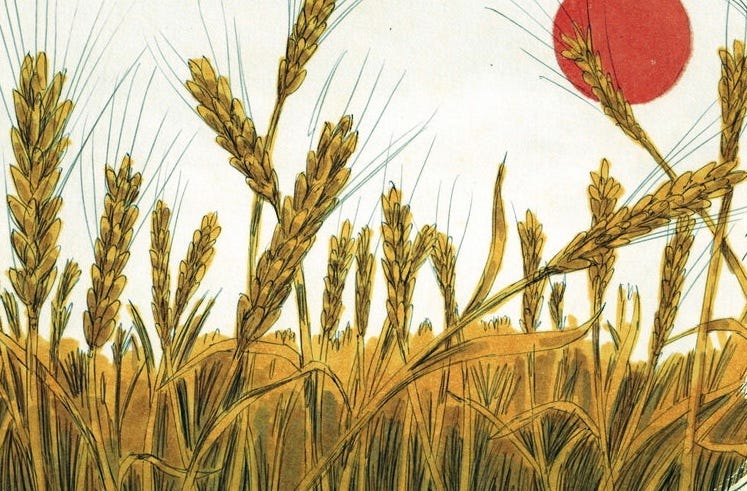
Image Source: Sweet Media (Creator), Biblical illustration of Gospel of Mark Chapter 4, Wikimedia Commons, CC BY-SA 3.0
.jpg)
Worth reading:
Blanchard, J. (2017). Read Mark Learn. Welwyn Garden City, UK: EP Books.
Boice, J.M. (1983). The Parables of Jesus. Chicago: Moody Publishers.